2012 Kyoto, Japan
In 2012, Doshisha University held a competition to build a new chapel and Center for Christian Culture sited upon adjacent sites on their Kyoto campus.
BAKOKO, in collaboration with engineers Structured Environment, proposed to connect the two new facilities with a bridging roof. The notion of continuity is extruded within the cores of this figure-eight formation, to house two sanctuaries devoted to religious worship and culture.
It is a building where structure, form, and function are molded into a singular totality. Our intention is not to draw attention to the form of the building, but rather, to merge floor, walls, and roof into an immersive experience prioritizing personal reflection and human interaction within the central sanctums.
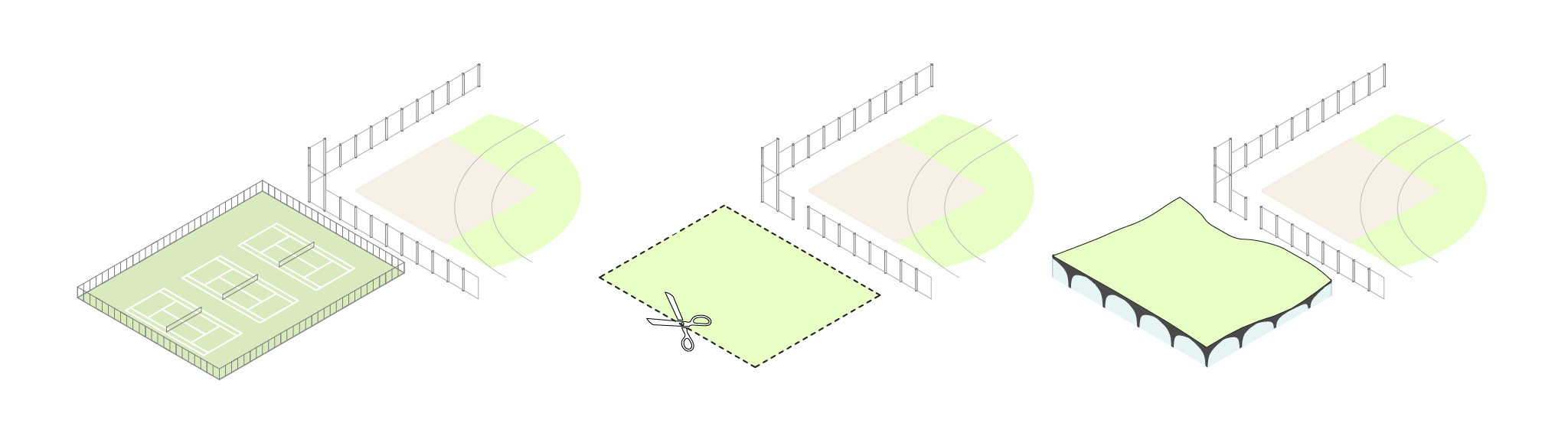
At the point where the loops merge, the roof arches over a campus thoroughfare, linking two new buildings dedicated to worship and parochial classes, gatherings, and exhibitions. The green roof reduces rainwater runoff and also helps to offset the loss of plants and trees which previously inhabited these greenfield sites.
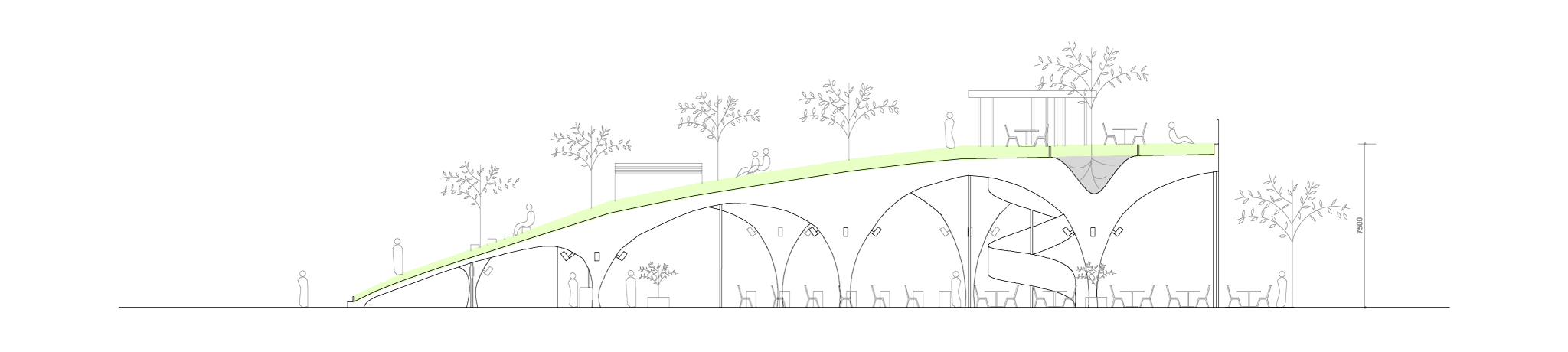
One of the university’s motivations to build this new facility was to host lucrative weddings in the chapel, with the complementary cultural center serving as an occasional reception venue. The wedding procession can symbolically walk across the undulating roofscape from chapel to reception – via an elevator and stairs – to mark the special occasion. In day-to-day operation, the roof will be a publically accessible gathering and relaxation space for students.
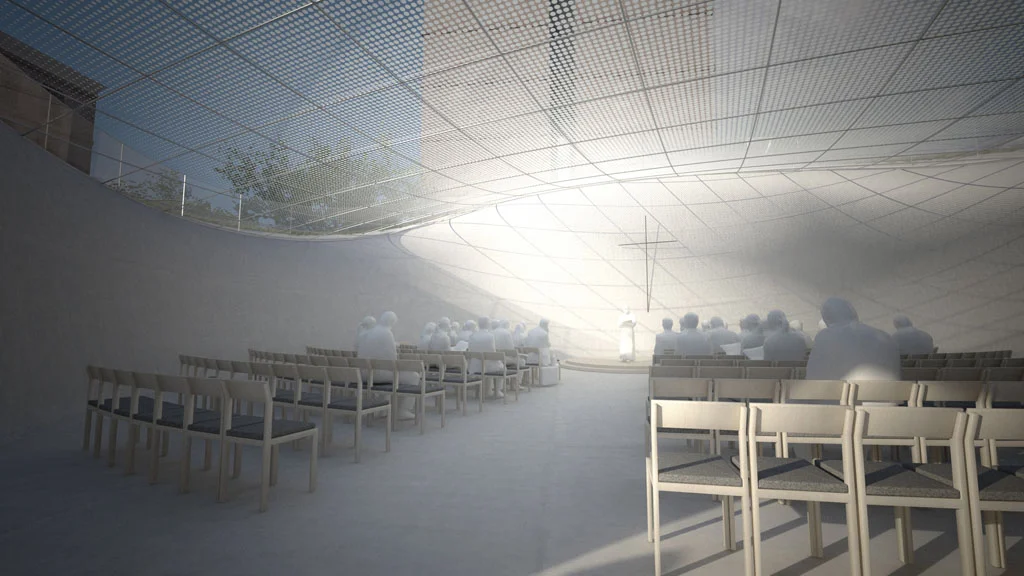
Nested within the opposite cores are twin sanctuaries devoted to worship and education. The smooth concrete forms encircling these spaces have no hard corners or boundaries. They appear limitless and are intended to permit and encourage free flexible forms of worship and communication.
Suspended cable nets support the glazed roof above each core – held in rigid tension due to their saddle-like curvature – without visually obstructing views to the sky above. A gradated frit pattern is applied to the overhead glass, shading worshippers in the center, but becoming less dense at the edges where sunlight filters onto the concrete.
The curved concrete walls and floors arch up and outward, deriving their structural integrity from their shell-like double curvature. The roof cantilevers outward over the support and circulation spaces arrayed around the facilities’ perimeter. The building is almost entirely wrapped by a full-height glass facade that exposes the concrete form of the sanctuaries to views from the exterior. The concrete floors of the building follow the subtle topography of the site. and merge with the sanctuary walls – a move that enhances seamless continuity with and gives the impression that the structure is an extension of the ground.
同志社大学 礼拝堂・キリスト教文化センター
2012 京都
2012年に、同志社大学の礼拝堂・キリスト教文化センターのオープンコンペティションが開催された。BAKOKOは、Structured Environmentと共同で、神聖なる空間をデザインするという、とても興味深いこのプロジェクトのデザインを進めた。デザインコンセプトは、神と人間の永遠の関係を象徴するInfinity(永遠)を表す8の字の形状、神と人・会衆同士の交流の”架け橋”となるアイコン的なアーキテクチャー、皆が集える敷地の緑の印象を残したランドスケープ、の両方の機能を兼ね備えたデザインである。
ルーフガーデンで繋っているランドスケープ状の2つの施設を統合する建物は、なだらかな丘のような統一感を与える。我々は、建物の形状よりも、壁、フロアや屋根等が一つになり、その中での人々の流れや活動を包括しうる、空間デザインを試みた。
ルーフガーデンのループが交差する部分が、祈りの場である礼拝堂と集いの場である文化センターの2つの施設を繋げるブリッジの役割を果たしている。緑化したルーフガーデンは、アウトドアのイベントの場となり、又、敷地に緑を保つ役割を果たす。
晴れの日には、ルーフガーデンでの野外結婚式が可能であり、階段やエレベーターを使用して、ルーフカーデンから、披露宴会場の文化センター内のラウンジへと、直接移動が可能である。又、通常は学生達がピクニックや読書等ができる、憩いの場として活躍する。
床・壁・天井が一体になった滑らかな形状のコンクリートシェルで形成されたループの中心の2つのコアのスペースは、祈りの場の礼拝堂と憩いの場のラウンジである。祈りの場や集いの場に相応しい
小宇宙のようなその空間は、人々が各々の活動を満喫できる空間となっている。
コアスペース上のケーブルで支えられた皮膜式のスカイライトから、天上の空が眺望でき、恵みの光が空間に降り注ぐ。スカイライトに施されたクロスの遮光パターンが、礼拝堂内部でクロスの陰となる。屋根の端にいく程薄くなるパターンは、壁沿いに光の輪を通すので、天使の輪のような光が礼拝堂に降り注ぐ。このような、幻想的な空間の礼拝堂は、神と人間との対話の空間に相応しい。
床・壁・天井が一体になった滑らかな形状のコンクリートシェル構造の漏斗上のコンクリート製のコアの外側は、ガラスファサードなので、内と外の境界線がなくなり、建物やインテリア空間がランドスケープの一部となったような、錯覚が起こる。